




Project: OptiQ - Non-standard Data and Image Processing: from Nonlinear Optics to Quantum Computing
Funding: Horizon Europe, MSCA Staff Exchanges 2021 (HORIZON-MSCA-2021-SE-01), Grant No. 101080374
Lead Institution: Silesian University of Technology, Gliwice, Poland
Consortium Partners: Austrian Institute of Technology (AIT); Security Business Austria; LG Nexera, Vienna; Boson Energy,
Luxembourg; Envelo, Warsaw
About the OptiQ Project
The OptiQ project represents a bold, interdisciplinary initiative uniting academia, research institutes, and industry across Europe under a common purpose: to achieve beyond-state-of-the-art progress in quantum optics and its applications to quantum computing and communication. Led by the Silesian University of Technology in Gliwice, the project brings together a consortium of five organizations spanning Poland, Austria, Luxembourg, and beyond.
The project focuses on non-standard data and image processing methods that promise transformative advances in quantum computing. Its scope encompasses the production of entangled photons and their application to qubit generation, quantum security, quantum blockchain technology, and quantum communication. A particularly innovative strand of the project involves developing an Augmented Reality (AR)-aided simulator and designer for optical quantum setups, a tool that bridges the gap between abstract quantum theory and practical implementation.
Particular attention is paid to the wide and efficient dissemination and communication of results, ensuring that scientific achievements reach not only the research community but also society at large. Through these measures, OptiQ strengthens the career prospects of participating scientists and helps increase the global competitiveness of the European Research Area and European industry in quantum computing and communication.
Research Objectives
The scientific goals pursued within the project include:
- Development and validation of a quantum optics-based image processing protocol as an experimental proof-of-concept.
- Development of a game demonstrating violations of Bell’s inequalities, involving real users and validated as an experimental proof-of-concept.
- Development of image representation methods in optical quantum systems , validated as an experimental proof-of-concept.
Innovation Objectives
The innovation-oriented goals include:
- Development of an augmented reality-based tool for the design, visualization, and simulation of optical quantum systems , demonstrated under near-real operational conditions.
- Development of methods for object detection and recognition using real NISQ (Noisy Intermediate-Scale Quantum) computers, demonstrated through prototype implementations under near-real conditions.
Research Visits and Laboratory Collaboration: Bringing Quantum Technologies to Life
One of the most exciting aspects of the OptiQ project has been the opportunity to connect cutting-edge theoretical research with real-world quantum technologies. As part of the international secondment program, researchers from the Silesian University of Technology visited the laboratories of the Austrian Institute of Technology (AIT Austria), gaining direct access to advanced quantum optics facilities and experimental systems.
While much of the early work within OptiQ focused on theoretical modeling, quantum image processing, and the development of an augmented reality (AR)-based design environment, the visit to AIT provided a unique opportunity to observe how quantum optical systems operate outside textbooks and computer simulations. It allowed researchers to move from abstract concepts to hands-on experience with the technologies that are shaping the future of quantum communication and quantum computing.
In the laboratories, researchers explored sophisticated experimental setups for generating, manipulating, and measuring quantum states of light. Optical tables populated with lasers, mirrors, beam splitters, photon sources, and highly sensitive detection systems revealed the remarkable precision required to conduct quantum experiments. Every component, no matter how small, plays a crucial role in ensuring that quantum information can be transmitted, measured, and processed accurately.
Beyond observing the equipment itself, the visit provided valuable insights into the practical challenges faced by scientists and engineers working with quantum technologies. Researchers learned how optical systems are assembled and calibrated, how alignment procedures are performed with extreme precision, and how factors such as thermal stability, mechanical tolerances, and environmental vibrations can influence experimental outcomes.
These observations proved particularly important for one of OptiQ’s major innovation goals: developing an augmented reality platform for designing and simulating quantum optical systems. By studying real laboratory environments, the team identified which physical characteristics and operational constraints must be represented in the virtual world. This knowledge is helping to create a digital environment that mirrors the complexity and behavior of real quantum laboratories, making advanced quantum technologies more accessible for education, training, and research.
Equally valuable were discussions with experts at AIT Austria, who shared their experience in developing robust and scalable quantum optical systems. These exchanges highlighted the growing transition of quantum technologies from laboratory prototypes toward practical applications with industrial relevance. Understanding these trends helps ensure that the solutions developed within OptiQ address not only current scientific challenges but also future technological needs.
The visit laboratory demonstrated the power of international collaboration in accelerating scientific discovery. By combining expertise from universities, research institutes, and industry partners across Europe, the OptiQ consortium is building the foundations for next-generation tools in quantum image processing, quantum communication, and immersive digital technologies.
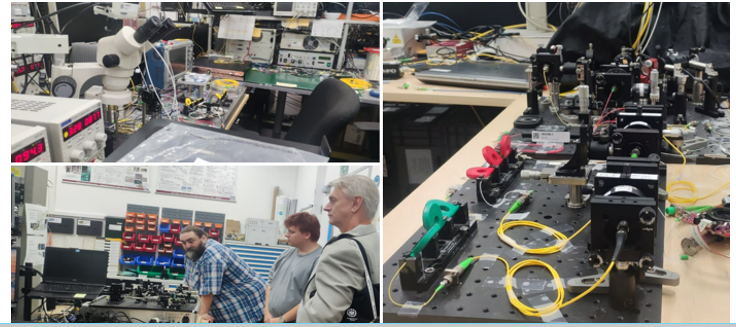
   Researchers from the OptiQ project visiting advanced quantum optics laboratories at AIT Austria,
  where real-world experimental systems provided valuable insights for the development of the AR
simulator.
The experience gained during this visit continues to influence the project’s development, ensuring that the innovative tools emerging from OptiQ are grounded in real scientific practice while opening new possibilities for how future researchers will learn, design, and interact with quantum technologies.
Quantum Image Processing: Advancing the Future of Visual Information in Quantum Systems
One of the most promising research directions within the OptiQ project is exploring how images can be represented and processed using quantum technologies. As quantum computing continues to evolve, researchers worldwide are investigating new ways to harness quantum phenomena to process visual information more efficiently than classical computing systems.
As part of the research activities carried out within the OptiQ project, a doctoral researcher participating in the international secondment program contributed to the development of a General Quantum Image Representation Model and Framework (GEQIE) . This work addresses one of the fundamental challenges in quantum image processing: how to represent image data within a quantum computing environment in a way that is both mathematically rigorous and practically applicable.
The developed framework provides a unified approach to quantum image encoding and creates a flexible environment in which researchers can explore, compare, and evaluate different quantum image representation methods. Built using the Qiskit quantum computing ecosystem, the framework serves as a valuable research tool for future investigations into quantum image analysis, image recognition, and quantum-enhanced computer vision.
Beyond its scientific contribution, the framework demonstrates how emerging quantum technologies can be applied to real-world data-processing challenges. By enabling experimentation with different image encoding strategies and simulation techniques, the work helps lay the foundations for future advances in quantum computing applications involving visual information.
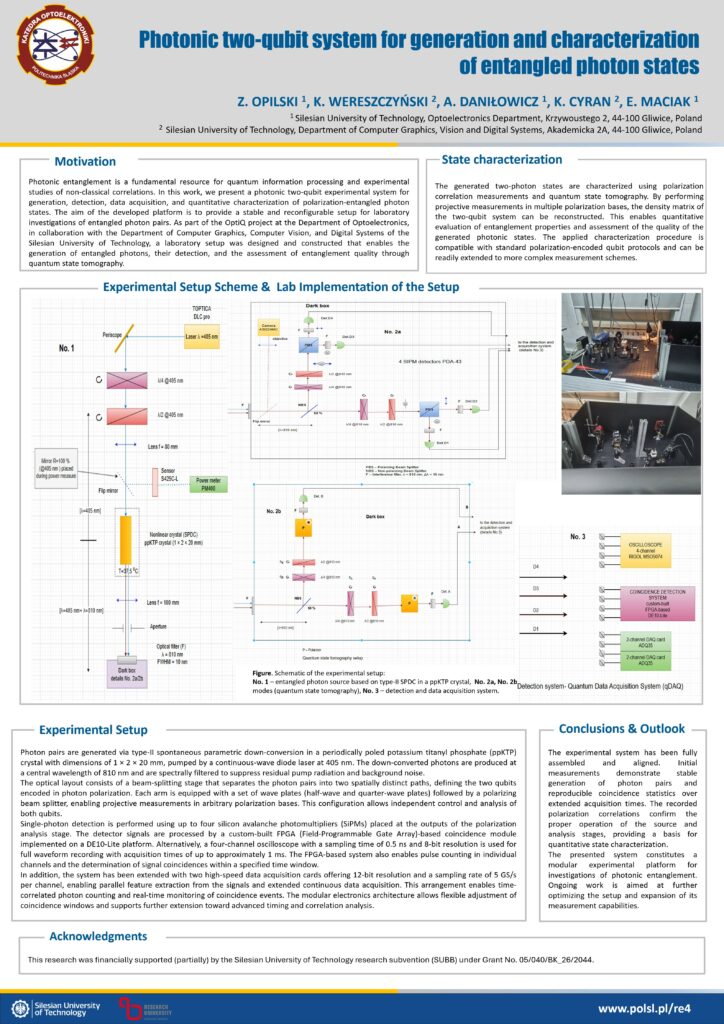
As part of the project’s dissemination activities, the research outcomes were presented in a scientific poster that showcased the General Quantum Image Representation Model and Framework. The poster highlights the mathematical foundations of the approach, the software architecture developed within the project, and experimental demonstrations of quantum image encoding methods. In addition, the dissemination activities included the presentation of a scientific poster entitled Photonic Two-Qubit System for Generation and Characterization of Entangled Photon States, which demonstrated the design and implementation of an experimental photonic platform for generating, detecting, and characterizing polarization-entangled photon pairs, including the associated quantum state tomography and data acquisition systems.
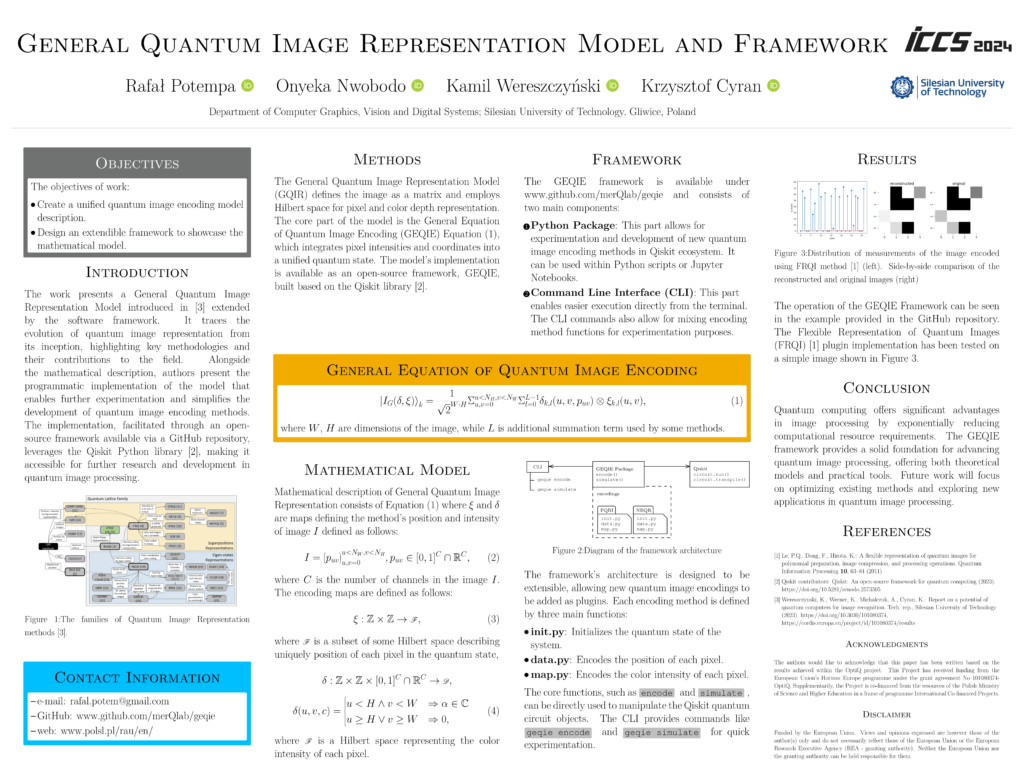
Poster presenting the General Quantum Image Representation Model and
 Framework (GEQIE), developed as part of research
activities conducted within the OptiQ project.
A Reconfigurable Photonic Testbed for Generating, Measuring, and Validating
Entangled Quantum States
The framework was designed with future growth in mind. Its modular architecture allows researchers to incorporate new quantum image representation techniques and extend existing methods as the field continues to evolve. This flexibility ensures that the work can support future scientific developments and serve as a platform for continued research in quantum image processing.
The development of GEQIE illustrates the collaborative and interdisciplinary nature of the OptiQ project, bringing together expertise in computer science, image processing, quantum computing, and software engineering. It also highlights how international secondments within the project are creating opportunities for young researchers to contribute directly to emerging scientific fields while disseminating new knowledge to the wider research community.
As quantum technologies move from laboratory research toward practical applications, initiatives such as GEQIE provide important building blocks for the next generation of intelligent image-processing systems, helping to unlock new possibilities at the intersection of quantum computing and visual information processing.
Augmented Reality for the Visualization and Exploration of Quantum Optical Systems
Among the most innovative outcomes emerging from the OptiQ project is the development of an augmented reality (AR)-based platform for the design, visualization, and simulation of quantum optical systems . By combining immersive digital technologies with advanced quantum research, the project is opening new possibilities for how scientists, engineers, and students interact with complex quantum environments.
Quantum optical systems are often composed of numerous interconnected components, including lasers, mirrors, beam splitters, detectors, and photon sources. Understanding how these elements interact within a three-dimensional experimental setup can be challenging, particularly for newcomers to the field. Traditional diagrams and static visualizations frequently fail to capture the spatial complexity of modern quantum laboratories.
To address this challenge, researchers within the OptiQ project have been developing an augmented reality environment that enables users to explore and interact with quantum optical systems in an intuitive and immersive way. Instead of relying solely on theoretical descriptions, users can visualize laboratory configurations in three-dimensional space, examine component relationships, and better understand how quantum optical experiments are assembled and operated.
The development of the platform was strongly informed by observations gathered during research visits to leading quantum optics laboratories. Insights gained from real-world experimental environments helped ensure that the virtual models accurately reflect practical considerations such as component positioning, alignment procedures, spatial constraints, and system integration requirements. As a result, the platform bridges the gap between theoretical design and practical implementation.
Beyond its value for research, the technology has significant educational potential. The AR environment can support training activities, laboratory preparation, collaborative system design, and knowledge transfer, making advanced quantum technologies more accessible to students and early-career researchers. By creating a realistic and interactive representation of quantum optical systems, the platform contributes to a new generation of digital tools for scientific learning and experimentation.
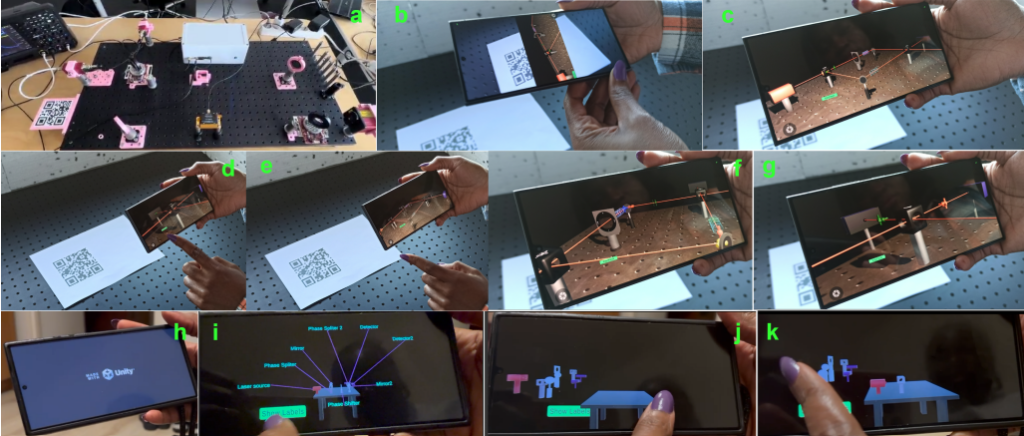
Augmented Reality environment developed within the OptiQ project for the visualization, design, and simulation of quantum
optical systems.
One notable outcome of this work is a scientific publication presenting the use of augmented reality technologies to support the visualization and modeling of quantum optical systems. The publication demonstrates how immersive technologies can simplify the understanding of complex experimental environments while providing new opportunities for education, design support, and collaborative research.
The work represents an important contribution to the growing intersection of the following:
- Quantum Technologies
- Extended Reality (XR)
- Computer Vision
- Human–Computer Interaction
- Scientific Visualization
- Digital Engineering Education
By integrating expertise from these diverse fields, the OptiQ project showcases how emerging technologies can work together to accelerate scientific discovery and make advanced research more accessible to broader audiences.
Learn More
Researchers and readers interested in the technical aspects of the augmented reality platform, its application to quantum optical systems, and the outcomes of the OptiQ Project are invited to explore the scientific publication resulting from this work:
Nwobodo, O., et al. Augmented Reality for the Design and Visualization of Quantum Optical Systems , Proceedings of the International Conference on Control, Decision and Information Technologies (CoDIT 2025).
DOI: 10.1109/CoDIT66093.2025.11321627
Werner, Krzysztof, et al . “Error reduction for image encoding-reconstruction for quantum photonic systems.” 2025 11th International Conference on Control, Decision and Information Technologies (CoDIT) . Vol. 1. IEEE, 2025.
DOI: 10.1109/CoDIT66093.2025.11321676
Potempa, Rafał, et al. “FRQI Pairs method for image classification using Quantum Recurrent Neural Network.” 2025 11th International Conference on Control, Decision and Information Technologies (CoDIT) . Vol. 1. IEEE, 2025.
DOI: 10.1109/CoDIT66093.2025.11321716
Faisal, Sundas, et al. “Advancements and Challenges in Linear Quantum Optics: A Comprehensive Review of Quantum Information Processing.” 2025 11th International Conference on Control, Decision and Information Technologies (CoDIT) . Vol. 1. IEEE, 2025.
DOI: 10.1109/CoDIT66093.2025.11321337
Daniłowicz, Anna, et al. “Game-Based Generation of Binary Data for Use in Bell Inequality Experiments.” 2025 11th International Conference on Control, Decision and Information Technologies (CoDIT) . Vol. 1. IEEE, 2025.
DOI: 10.1109/CoDIT66093.2025.11321826
This publication provides a detailed overview of the system architecture, visualization techniques, modeling approach, and the role of augmented reality in supporting the design and simulation of quantum optical environments developed within the OptiQ project.
As OptiQ Approaches Its Final Chapter: Celebrating Achievements and Lasting Impact
As the OptiQ project enters its final year, it stands as a remarkable example of how international collaboration can drive innovation at the frontiers of quantum technologies, image processing, and immersive digital systems.
Since its launch under the Horizon Europe program, OptiQ has brought together researchers, engineers, doctoral candidates, and industry experts from across Europe to address some of the most challenging questions in quantum optics and quantum information processing. Through a unique combination of academic excellence, industrial engagement, and international mobility, the project has created an environment where ideas could be transformed into tangible scientific and technological outcomes.
Over the course of the project, numerous milestones have been achieved.
Researchers have successfully established a strong interdisciplinary network connecting universities, research institutes, and industrial partners. International secondments enabled knowledge exchange across countries and sectors, allowing researchers to gain hands-on experience in advanced laboratories and industrial environments while contributing to cutting-edge research activities.
Among the project’s key scientific achievements are significant advances in quantum image processing , including the development of the General Quantum Image Representation Model and Framework (GEQIE) . This work has contributed to the growing field of quantum-enhanced image analysis and has provided researchers with tools to explore new approaches for representing and processing visual information using quantum systems.
The project has also delivered important progress toward one of its major innovation goals: the development of an augmented reality-aided platform for the design, visualization, and simulation of quantum optical systems . By combining immersive technologies with quantum optics, the platform offers new possibilities for education, training, research, and experimental design, helping bridge the gap between theoretical concepts and real-world laboratory implementations.
Another notable achievement has been the successful dissemination of project results through scientific publications, conference presentations, workshops, outreach activities, and international collaborations. These efforts have helped raise awareness of emerging quantum technologies while strengthening the visibility of European research on the global stage.
The project has further contributed to the professional development of early-stage researchers, providing opportunities to participate in international research visits, collaborate with leading experts, develop interdisciplinary skills, and contribute directly to impactful scientific outcomes.
As OptiQ moves toward its conclusion, work continues on final demonstrations, validation activities, scientific publications, and knowledge-transfer initiatives. These final efforts will consolidate the project’s achievements and ensure that the knowledge, tools, and collaborations established during the project continue to generate value long after its formal completion.
Perhaps the most enduring outcome of OptiQ will be its legacy: a network of researchers and institutions united by a shared vision of advancing quantum technologies and their practical applications. The partnerships established through the project have created foundations for future research initiatives, new collaborations, and continued innovation across Europe and beyond.
The Silesian University of Technology is proud to coordinate and contribute to this ambitious endeavor. As the project reaches its final stage, the University celebrates the achievements of all partners and researchers who have helped transform innovative ideas into meaningful scientific progress.
While the OptiQ project may be approaching its conclusion, the knowledge generated, technologies developed, and collaborations established will continue to shape future advances in quantum computing, quantum optics, image processing, and immersive technologies for years to come.